
Python Developer in Hyderabad: Complete Roadmap to Become Job-Ready in 2026
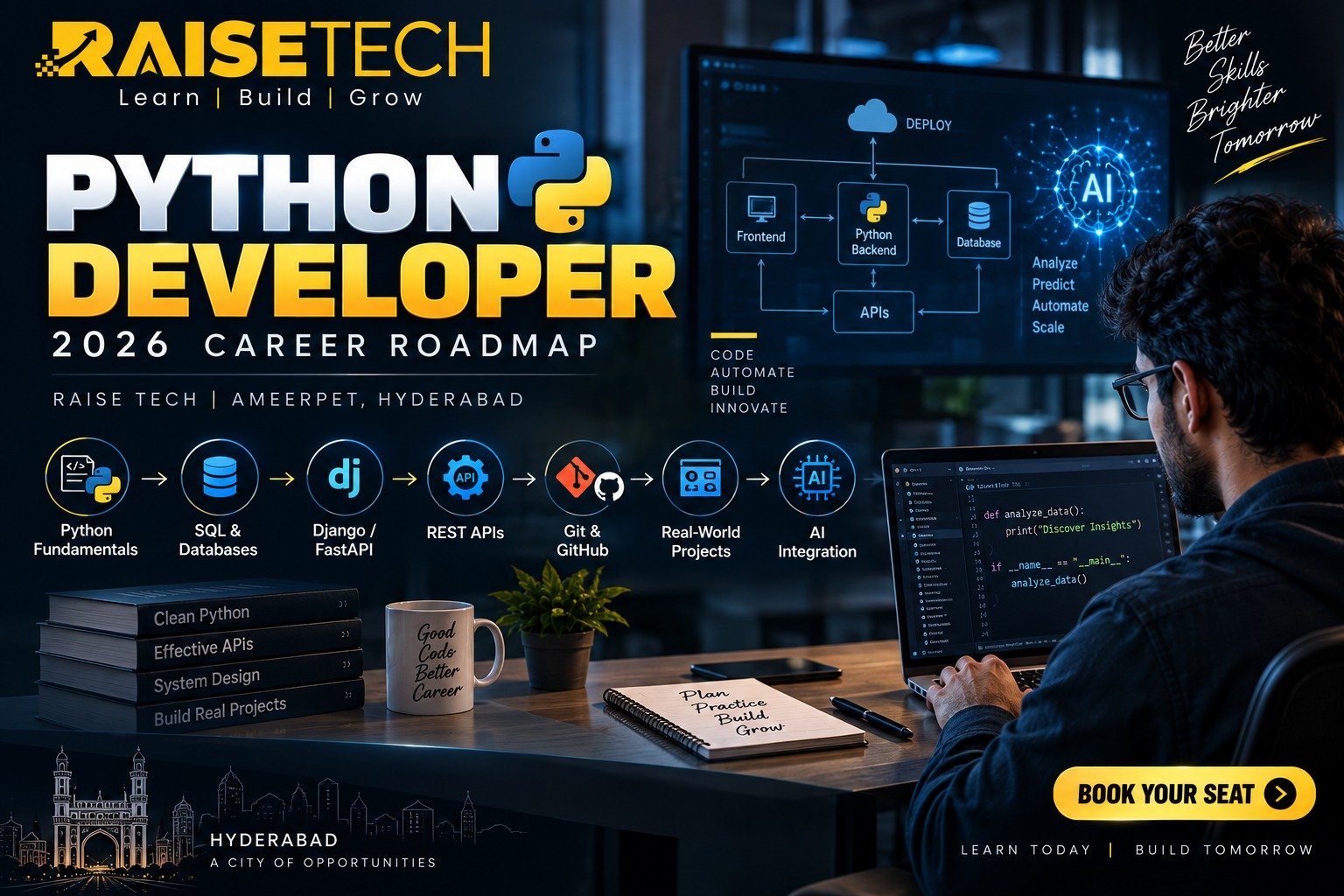
Key idea: Do not learn Python as a list of commands. Learn it as a tool for solving real problems.
What Does a Python Developer Actually Do?
A Python Developer may develop backend applications, build REST APIs, work with databases, automate repetitive tasks, integrate third-party APIs, process data or build AI-powered applications. For example, an application can follow this flow:
Web Interface → Python Backend → REST API → Database → Business Logic → AI Feature
Understanding this complete flow is what turns programming knowledge into practical development ability.
Python Developer Roadmap 2026
If you are a beginner wondering how to become a Python Developer, follow a structured sequence rather than trying to learn every library at once.-
-
Learn Core Python
Start with Python syntax, variables, data types, operators, conditions, loops, functions, collections, modules, exception handling and file handling. Then move to Object-Oriented Programming, classes, objects, inheritance, polymorphism, encapsulation, decorators, generators, iterators, virtual environments and package management. The goal is not to memorize syntax. Write programs, solve problems, debug errors and build small applications. -
Learn SQL & Databases
Python applications frequently work with data. Learn SELECT, WHERE, GROUP BY, ORDER BY, JOIN, subqueries, constraints, indexes, transactions and CRUD operations. Then practice with databases such as PostgreSQL, MySQL or SQLite. -
Learn Web Development Fundamentals
For a Python Full Stack Developer path, learn the basics of HTML, CSS, JavaScript, HTTP, JSON and REST APIs. This helps you understand how frontend applications communicate with Python backend systems. -
Learn Django or FastAPI
Django is useful for full-featured web applications, while FastAPI is widely used for modern API-first Python services. Flask is another framework you may encounter. Choose a primary framework first and build projects with it instead of trying to master all frameworks simultaneously. -
Master REST APIs
Learn GET, POST, PUT, PATCH, DELETE, HTTP status codes, JSON, authentication, authorization, JWT, validation and API error handling. A real-world example is an online food-ordering application where a frontend requests nearby restaurants, the Python backend processes the request, communicates with the database and returns JSON to the frontend. -
Testing & Git
Professional development includes more than writing code. Learn Git, GitHub, branching, pull requests, testing and debugging. Use GitHub to create a portfolio containing project source code, README files, API documentation and deployment information. -
Learn Deployment & Cloud Basics
Understand Linux basics, environment variables, Docker, cloud deployment and CI/CD fundamentals. A project that works locally is only one part of the development lifecycle. Learn how applications are prepared and deployed for real users. -
Add AI to Python
Python connects strongly with AI, machine learning, data and automation. You can explore LLM APIs, prompt engineering, RAG, embeddings, vector databases, AI agents, AI APIs and AI-assisted development. For example:Python + Database + API can evolve into: Python + Database + API + LLM + RAG + AI AssistantThis is one way a traditional application can gain modern AI capabilities.
-
What Should a Python Developer Build?
Build projects instead of collecting certificates.- Project 1 – Automation Toolkit: Excel processing, file management, email automation and API integration.
- Project 2 – Employee Management System: Python + SQL + REST API.
- Project 3 – E-Commerce Backend: Python + FastAPI/Django + PostgreSQL.
- Project 4 – Data Analysis Dashboard: Python + Pandas + NumPy + visualization.
- Project 5 – AI Assistant: Python + LLM API + RAG.
- Project 6 – Full Stack Application: Python backend + React frontend + database + APIs.
Portfolio Tip: Your portfolio should demonstrate what you can build, not only what you studied.
Python Developer Career Paths
Python can connect with several technology roles.- Python Developer – Python, OOP, SQL, Git.
- Backend Developer – Python, Django/FastAPI, REST APIs.
- Python Full Stack Developer – Python, APIs, React, SQL.
- Automation Engineer – Python, APIs, scripting.
- Data Analyst – Python, Pandas, SQL, Power BI.
- Data Scientist – Python, statistics, machine learning.
- AI Application Developer – Python, LLM APIs, RAG.
- ML Engineer – Python, machine learning and deployment.
- AI/GenAI Developer – Python, LLMs and AI application frameworks.
Why Learn Python at Raise Tech, Ameerpet?
At Raise Tech, Ameerpet, Hyderabad, the focus is on moving learners from concepts to implementation. The practical approach can be represented as:
Learn → Practice → Build → Review → Improve
Learners can work on hands-on coding, real-time scenarios, lab practice, project-based assignments, code reviews and career preparation.
The program approach can include practical exposure to Python, SQL, backend development, APIs, projects and AI integration, depending on the current batch curriculum.
The goal is simple: help learners move from “I understood the concept” to “I can implement the concept.”
Who Can Learn Python?
A Python career path can be considered by B.Tech students, B.Sc students, BCA students, MCA students, graduates, freshers, working professionals and career switchers. The important factor is not trying to learn everything at once. Follow a structured sequence and practice consistently.Python + AI: A Modern Learning Path
A practical learning sequence is:
Python Fundamentals → OOP & Advanced Python → SQL & Databases → Web Fundamentals → Django/FastAPI → REST APIs → Git & GitHub → Testing → Docker & Deployment → Data & Automation → Generative AI Integration → Capstone Project → Interview Preparation
This creates a clear path from programming fundamentals to application development and modern AI integration.
The Real Difference Is Not “Learning Python”
Many learners search for a Python course, but the more important question is: What will you actually build after learning Python? A strong learning journey has three stages:- Stage 1 – Understand: Learn the concepts.
- Stage 2 – Implement: Write code and solve problems.
- Stage 3 – Build: Create projects that demonstrate your skills.
Python Developer in Hyderabad – Choosing a Training Program
If you are comparing Python Training in Hyderabad, Python Course in Hyderabad or Python Training in Ameerpet, compare the actual learning experience rather than only the course title. Look at curriculum, practical labs, mentor interaction, project work, code practice, Git/GitHub exposure, interview preparation, career guidance and the current batch structure. Ask what you will actually implement during the program.
Career Tip: Before choosing a training program, ask what projects you will build, what technologies you will practice and how much hands-on coding is included.
Start Your Python Developer Journey with Raise Tech
If your goal is to become a Python Developer, start with the right sequence. Learn Python. Build applications. Work with databases. Create APIs. Build real projects. Integrate AI. Prepare your portfolio. Prepare for interviews. At Raise Tech, Ameerpet, Hyderabad, the training approach is designed around practical implementation and project-oriented learning.Learn | Build | Grow
“` If you are interested in starting your Python journey, visit the Raise Tech website to explore the current Python program, batch details and admission process. Website: www.raisetech.in Location: Raise Tech, Ameerpet, Hyderabad Phone: +91 96422 10326 “`Frequently Asked Questions About Python Development
What is a Python Developer?
A Python Developer is a software professional who uses Python to build applications, backend services, APIs, automation workflows, data solutions or AI-powered applications.How can I become a Python Developer in Hyderabad?
Start with Core Python, OOP, SQL and Git. Then learn Django or FastAPI, REST APIs, testing and deployment. Build practical projects and prepare a portfolio before applying for developer roles.Is Python suitable for beginners?
Yes. Python is widely used as a starting programming language because its syntax is relatively readable. Becoming job-ready still requires consistent practice, problem-solving and project development.What should I learn after Python?
Depending on your target role, learn SQL, Django, FastAPI, REST APIs, databases, automation, data analytics, machine learning or Generative AI.What projects should a Python Developer build?
Examples include automation tools, REST APIs, employee management systems, e-commerce backends, data analysis applications and AI-powered applications.Can Python be combined with AI?
Yes. Python is widely used in AI and machine learning workflows and can integrate LLM APIs, RAG systems and other AI application features.
Ready to start your Python journey?
Explore Python training at Raise Tech, Ameerpet, Hyderabad and focus on learning, building and implementing real-world applications.
Recent Posts
Tagged FastAPI Training, Python Backend Developer, Python Course in Ameerpet, Python Developer Career, Python Developer Roadmap, Python Django Training, Python Full Stack Developer, Python Full Stack Training in Hyderabad, Python Jobs in Hyderabad, Python Programming Course, Python Projects, Python Training in Ameerpet, Python with AI, SQL Training in Hyderabad