
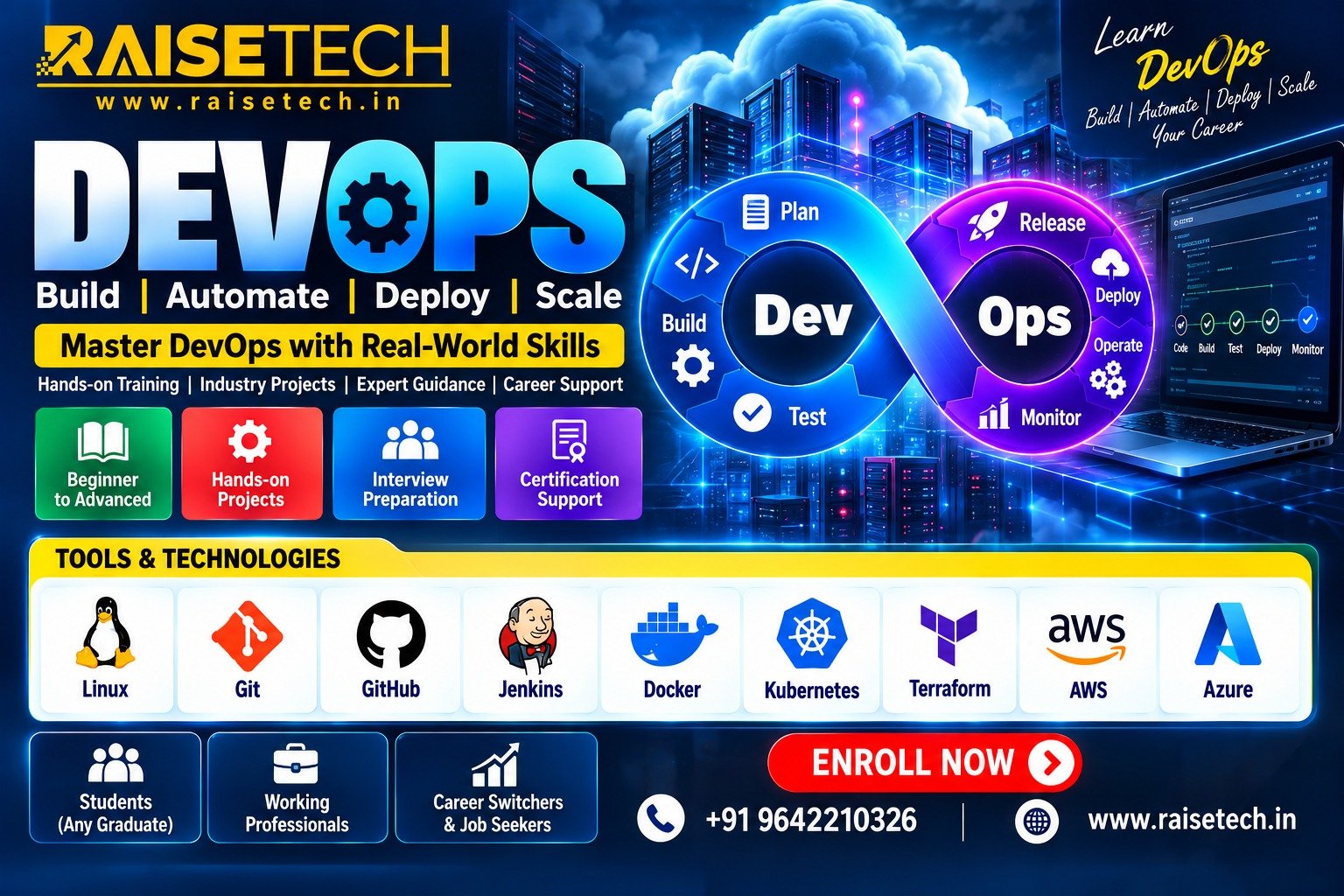
DevOps has become an important part of modern software development and IT operations. Organizations use DevOps practices to improve software delivery, automate repetitive tasks, manage infrastructure, streamline deployment processes, and support reliable application operations. Raise Tech’s DevOps Training in Hyderabad helps learners understand the tools, technologies, and practices used across modern DevOps environments.
The training introduces learners to essential DevOps concepts including Linux, Git, scripting, continuous integration, continuous delivery, Docker, Kubernetes, Jenkins, cloud platforms, Infrastructure as Code, automation, monitoring, and DevSecOps fundamentals. Learners can apply these concepts through practical exercises, projects, and industry-oriented scenarios.
Why Learn DevOps Training in Hyderabad?
Hyderabad is a major technology and IT services destination where students, fresh graduates, and working professionals can explore different technology career paths. DevOps skills are relevant to modern software delivery because development and operations teams increasingly work with automation, cloud infrastructure, continuous integration, continuous delivery, containers, and monitoring.
By choosing DevOps Training in Hyderabad, learners can develop a structured understanding of DevOps practices and technologies while gaining practical exposure to commonly used tools. The training is designed to help learners understand how code moves from development through testing and deployment into operational environments.
Learn DevOps Tools Under One Training Program
Instead of learning individual tools separately, this course introduces learners to DevOps as an integrated workflow. Learners can understand how Git, Linux, Jenkins, Docker, Kubernetes, Terraform, cloud platforms, monitoring tools, and automation technologies can work together as part of a modern software delivery process.
Importance of DevOps Engineer Training
Many organizations need efficient software development and deployment processes that can support frequent releases, automation, scalability, and reliable operations. DevOps brings development and operations practices closer together and uses automation and collaboration to improve software delivery workflows.
DevOps Engineer Training helps learners understand how applications are built, tested, packaged, deployed, monitored, and maintained through automated workflows. Learning these practices can help students and IT professionals develop practical knowledge relevant to cloud, infrastructure, software delivery, and operations environments.
Benefits of DevOps Training
- Learn DevOps fundamentals and software delivery practices.
- Understand Linux and command-line fundamentals.
- Learn Git and version control workflows.
- Develop CI/CD pipeline knowledge.
- Understand Docker and containerization.
- Learn Kubernetes and container orchestration fundamentals.
- Explore Infrastructure as Code concepts.
- Understand cloud infrastructure and deployment.
- Learn automation and configuration management fundamentals.
- Explore monitoring, logging, and troubleshooting.
- Understand DevSecOps and security fundamentals.
- Build skills relevant to DevOps and cloud infrastructure roles.
What You Will Learn in the DevOps Course
Raise Tech’s DevOps Course in Hyderabad follows a structured approach that starts with foundational concepts and progresses toward practical DevOps tools, automation, cloud integration, containerization, continuous delivery, monitoring, and infrastructure management.
DevOps Fundamentals
- Introduction to DevOps
- DevOps culture and collaboration
- DevOps lifecycle
- Continuous integration and continuous delivery
- Continuous deployment concepts
- Automation fundamentals
- DevOps tools and workflows
- Software development and operations integration
Linux and Shell Scripting
- Linux operating system fundamentals
- Linux commands and file management
- User and permission management
- Process management
- Package management
- Linux networking fundamentals
- Shell scripting fundamentals
- Automation using shell scripts
Git and Version Control
- Git fundamentals
- Repository management
- Git commands
- Branches and merging
- Git workflows
- Pull requests and collaboration
- Version control best practices
- Git-based project management
Jenkins and CI/CD
- Jenkins fundamentals
- Continuous Integration concepts
- Continuous Delivery concepts
- Jenkins installation and configuration
- Pipeline creation
- Build automation
- Automated testing workflows
- Deployment automation
- CI/CD pipeline troubleshooting
Docker and Containerization
- Containerization fundamentals
- Docker architecture
- Docker installation and configuration
- Docker images and containers
- Dockerfiles
- Docker volumes
- Docker networking
- Docker Compose fundamentals
- Container deployment
Kubernetes and Container Orchestration
- Kubernetes fundamentals
- Kubernetes architecture
- Pods and containers
- Deployments
- Services
- Namespaces
- ConfigMaps and Secrets
- Ingress fundamentals
- Scaling applications
- Rolling updates and rollbacks
- Kubernetes troubleshooting
Terraform and Infrastructure as Code
- Infrastructure as Code fundamentals
- Terraform architecture
- Terraform configuration
- Providers and resources
- Variables and outputs
- Terraform state
- Terraform modules
- Infrastructure provisioning
- Cloud infrastructure automation
Ansible and Configuration Management
- Ansible fundamentals
- Ansible architecture
- Inventory management
- Playbooks
- Tasks and modules
- Variables
- Roles
- Server configuration automation
Cloud and DevOps
- Cloud computing fundamentals
- Cloud infrastructure concepts
- DevOps and cloud integration
- Application deployment in cloud environments
- Cloud networking fundamentals
- Cloud security fundamentals
- Cloud monitoring
- Cloud automation
Monitoring and Logging
- Application monitoring fundamentals
- Infrastructure monitoring
- Metrics and alerts
- Log management fundamentals
- Prometheus fundamentals
- Grafana fundamentals
- Dashboard creation
- Monitoring and troubleshooting
DevSecOps Fundamentals
- Introduction to DevSecOps
- Security in CI/CD pipelines
- Secure coding concepts
- Secrets management fundamentals
- Container security fundamentals
- Security scanning concepts
- Infrastructure security
- DevOps security best practices
Hands-On DevOps Training in Hyderabad
Practical experience is an important part of learning DevOps. Our DevOps Training in Hyderabad focuses on combining technical concepts with practical exercises so learners can understand how different DevOps tools work together.
Learners can practice Linux administration, Git workflows, CI/CD pipelines, Docker containerization, Kubernetes deployments, infrastructure automation, cloud integration, monitoring, and troubleshooting concepts. Practical exercises help learners connect individual tools with complete DevOps workflows.
Practical Learning Includes
- Instructor-led technical sessions
- Linux and shell scripting exercises
- Git and version control practice
- Jenkins CI/CD pipeline exercises
- Docker containerization practice
- Kubernetes deployment exercises
- Terraform Infrastructure as Code practice
- Ansible automation exercises
- Cloud deployment scenarios
- Monitoring and troubleshooting exercises
- DevOps project-oriented learning
Online and Offline DevOps Training
Raise Tech provides flexible learning options for students and working professionals looking for AWS Azure Training in Hyderabad. You can choose online learning or classroom training depending on your schedule, location, and preferred learning environment.
Offline Classroom DevOps Training in Ameerpet
Join our DevOps Training in Ameerpet for face-to-face instructor-led learning. Classroom sessions provide opportunities to interact with trainers, ask questions, discuss DevOps concepts, understand tools, and participate in practical exercises.
Classroom-based learning can provide a structured environment for learners who prefer direct interaction and guided technical practice. Learners can work through DevOps concepts step by step while receiving trainer guidance during practical exercises.
Online DevOps Training
Prefer learning from home or the workplace? Our Online DevOps Training provides a flexible way to learn DevOps tools, CI/CD, Docker, Kubernetes, Terraform, cloud technologies, automation, and monitoring without needing to attend a physical classroom.
Online learning can be suitable for working professionals, students, and learners from locations outside Ameerpet who want instructor-led DevOps training while managing their existing schedules.
DevOps Engineer Job Assistance in Hyderabad
Technical knowledge is an important part of starting a DevOps career. Raise Tech also provides job assistance for DevOps Engineer training to help learners prepare for the recruitment process.
Our career-oriented support can help you improve your resume, prepare for technical interviews, understand common DevOps interview questions, discuss project experience, and present your practical skills to potential employers.
Career Support Includes
- Resume preparation guidance
- Technical interview preparation
- DevOps interview question practice
- Mock interview preparation
- Project and practical guidance
- Git and CI/CD interview preparation
- Docker and Kubernetes interview preparation
- Cloud and infrastructure interview guidance
- Career guidance for DevOps-related roles
Job assistance supports your job-search and interview preparation. Employment is subject to individual qualifications, experience, interview performance, and employer requirements.
Why Choose Raise Tech for DevOps Training?
Choosing the right training institute can help you build a structured understanding of DevOps technologies. Raise Tech combines instructor-led education, practical learning, project-oriented training, and career-focused support for learners interested in DevOps and cloud infrastructure.
Industry-Oriented Curriculum
Learn essential DevOps concepts, Linux, Git, CI/CD, Jenkins, Docker, Kubernetes, Terraform, Ansible, cloud infrastructure, monitoring, automation, and DevSecOps fundamentals through a structured curriculum.
Experienced Trainers
Our trainers explain technical concepts using practical examples and guide learners through DevOps tools, workflows, exercises, and real-world scenarios.
Hands-On Learning
Go beyond theory with practical exercises that help you understand Linux administration, Git workflows, CI/CD pipelines, containerization, Kubernetes deployments, infrastructure automation, monitoring, security, and DevOps operations.
Online and Offline Options
Choose classroom training in Ameerpet, Hyderabad or online training based on your learning preferences and schedule.
Project-Oriented Training
Apply DevOps tools and concepts through practical projects that bring together version control, continuous integration, containerization, cloud infrastructure, automation, deployment, and monitoring.
Career-Focused Approach
Build technical skills while also preparing for resumes, interviews, projects, and DevOps-related job opportunities.
Who Should Join DevOps Engineer Training?
The course is suitable for learners from different IT backgrounds who want to build skills in DevOps, automation, cloud infrastructure, continuous integration, continuous delivery, and modern software operations.
- Students interested in DevOps
- Fresh graduates starting an IT career
- Software developers
- System administrators
- Linux administrators
- Network engineers
- IT infrastructure professionals
- Cloud professionals
- Testing professionals
- Technical support professionals
- DevOps professionals looking to strengthen their skills
- IT professionals changing their career path
Career Opportunities After DevOps Training
After developing DevOps, cloud, automation, and infrastructure skills, learners can explore different technology career paths based on their existing experience, qualifications, and additional technical skills.
- DevOps Engineer
- Junior DevOps Engineer
- Cloud DevOps Engineer
- DevOps Automation Engineer
- CI/CD Engineer
- Cloud Engineer
- Cloud Infrastructure Engineer
- Release Engineer
- Build and Deployment Engineer
- Site Reliability Engineer
- Platform Engineer
- Cloud Operations Engineer
- DevOps Support Engineer
Job responsibilities can vary between organizations. Some DevOps roles may require additional knowledge of programming, Linux administration, networking, cloud platforms, Kubernetes, Infrastructure as Code, databases, security, or monitoring technologies.
DevOps Certification Preparation
DevOps professionals can pursue different certifications depending on their career goals, technical background, and preferred technology ecosystem. Certifications can help learners validate knowledge in areas such as cloud, Kubernetes, Linux, automation, and DevOps practices.
DevOps training can help learners strengthen their understanding of important concepts before pursuing relevant certifications. Certification preparation should be combined with hands-on practice and a strong understanding of the technologies covered by the selected certification.
DevOps Training for Students and Working Professionals
Students can use the course to build a foundation in DevOps and modern software delivery practices before entering the IT industry. Learning Linux, Git, CI/CD, Docker, Kubernetes, cloud, automation, and monitoring can introduce learners to technologies used across modern development and operations environments.
Working professionals can use the training to expand their existing technical knowledge. For example, developers, system administrators, testers, network professionals, cloud professionals, and technical support professionals can explore DevOps practices to broaden their infrastructure and software delivery skills.
The availability of both online and classroom learning makes it easier for learners to choose a training format that fits their professional and personal commitments.
DevOps Tools Covered in the Training
DevOps environments commonly involve multiple tools that support source code management, automation, continuous integration, continuous delivery, containerization, infrastructure provisioning, configuration management, cloud deployment, monitoring, and security. Raise Tech’s training introduces learners to important DevOps tools and concepts through a structured learning path.
- Linux
- Git
- GitHub
- Jenkins
- Docker
- Kubernetes
- Terraform
- Ansible
- Prometheus
- Grafana
- Cloud platforms
- CI/CD tools and technologies
The exact tools and practical exercises may vary based on the training curriculum and batch requirements. Learners can contact Raise Tech for the latest course syllabus and tool coverage.
DevOps Projects and Practical Learning
Projects can help learners understand how DevOps technologies work together in a complete software delivery workflow. Raise Tech’s practical approach helps learners connect individual tools with development, deployment, infrastructure, automation, and monitoring processes.
Learners can work with scenarios involving source code management, automated builds, CI/CD pipelines, Docker containers, Kubernetes deployments, infrastructure provisioning, cloud environments, monitoring, and troubleshooting.
Project-Oriented DevOps Learning Includes
- Source code management using Git
- Automated build workflows
- CI/CD pipeline development
- Docker-based application deployment
- Kubernetes application deployment
- Infrastructure provisioning with Terraform
- Configuration management with Ansible
- Cloud deployment concepts
- Monitoring and logging
- DevOps troubleshooting scenarios
Start Your DevOps Career with Raise Tech in Hyderabad
Build practical DevOps skills with Raise Tech’s DevOps Training in Hyderabad and Ameerpet.
Learn Linux, Git, CI/CD, Jenkins, Docker, Kubernetes, Terraform, Ansible, cloud infrastructure, automation, monitoring, and DevSecOps fundamentals through our career-focused training approach.
Whether you prefer offline DevOps training in Ameerpet or online DevOps training, Raise Tech provides learning options for students and IT professionals looking to develop modern DevOps skills.
Enquire today to learn about upcoming batches, course duration, fees, online training, classroom training, syllabus, practical projects, and enrollment options.
Frequently Asked Questions
Where can I learn DevOps Training in Hyderabad?
Raise Tech offers DevOps Training in Hyderabad for learners who want to develop practical skills in DevOps, automation, cloud infrastructure, CI/CD, Docker, Kubernetes, and related technologies. Classroom training options are available in Ameerpet based on the current batch schedule.
Is DevOps Training available in Ameerpet?
Yes, Raise Tech offers training options for learners looking for DevOps Training in Ameerpet. Contact the training team for current classroom schedules, batch availability, course duration, and enrollment details.
Does Raise Tech offer Online DevOps Training?
Yes. Learners who prefer remote education can choose Online DevOps Training. Online batches provide a flexible alternative to classroom training and can be suitable for students and working professionals.
Does the DevOps course include job assistance?
Raise Tech provides career-oriented support including resume guidance, technical interview preparation, project guidance, mock interview preparation, and job-search assistance. Job assistance does not guarantee employment.
Is DevOps Training suitable for beginners?
The course can be suitable for beginners with basic IT knowledge. Learners can start with DevOps fundamentals, Linux, Git, and software delivery concepts before progressing to CI/CD, Docker, Kubernetes, cloud, automation, and monitoring.
What tools are covered in DevOps Training?
The training introduces important DevOps technologies including Linux, Git, Jenkins, Docker, Kubernetes, Terraform, Ansible, cloud platforms, monitoring tools, and CI/CD concepts. The exact tools covered may vary based on the latest course curriculum.
Why should I learn Docker and Kubernetes?
Docker introduces learners to application containerization, while Kubernetes provides container orchestration concepts. Understanding both can help learners work with modern application deployment and cloud-native environments.
What is the role of Terraform in DevOps?
Terraform is an Infrastructure as Code technology that can be used to define and provision infrastructure through configuration files. Learning Infrastructure as Code can help DevOps professionals understand automated infrastructure provisioning and management.
What jobs can I apply for after DevOps Training?
Depending on your qualifications and experience, you can explore roles such as DevOps Engineer, Cloud DevOps Engineer, DevOps Automation Engineer, CI/CD Engineer, Cloud Engineer, Cloud Infrastructure Engineer, Release Engineer, Site Reliability Engineer, Platform Engineer, and Cloud Operations Engineer.
Is classroom DevOps Training available in Ameerpet?
Raise Tech offers classroom training options in Ameerpet based on available batches. Contact Raise Tech for the latest classroom schedule, location details, fees, course duration, and enrollment information.