
Course Overview
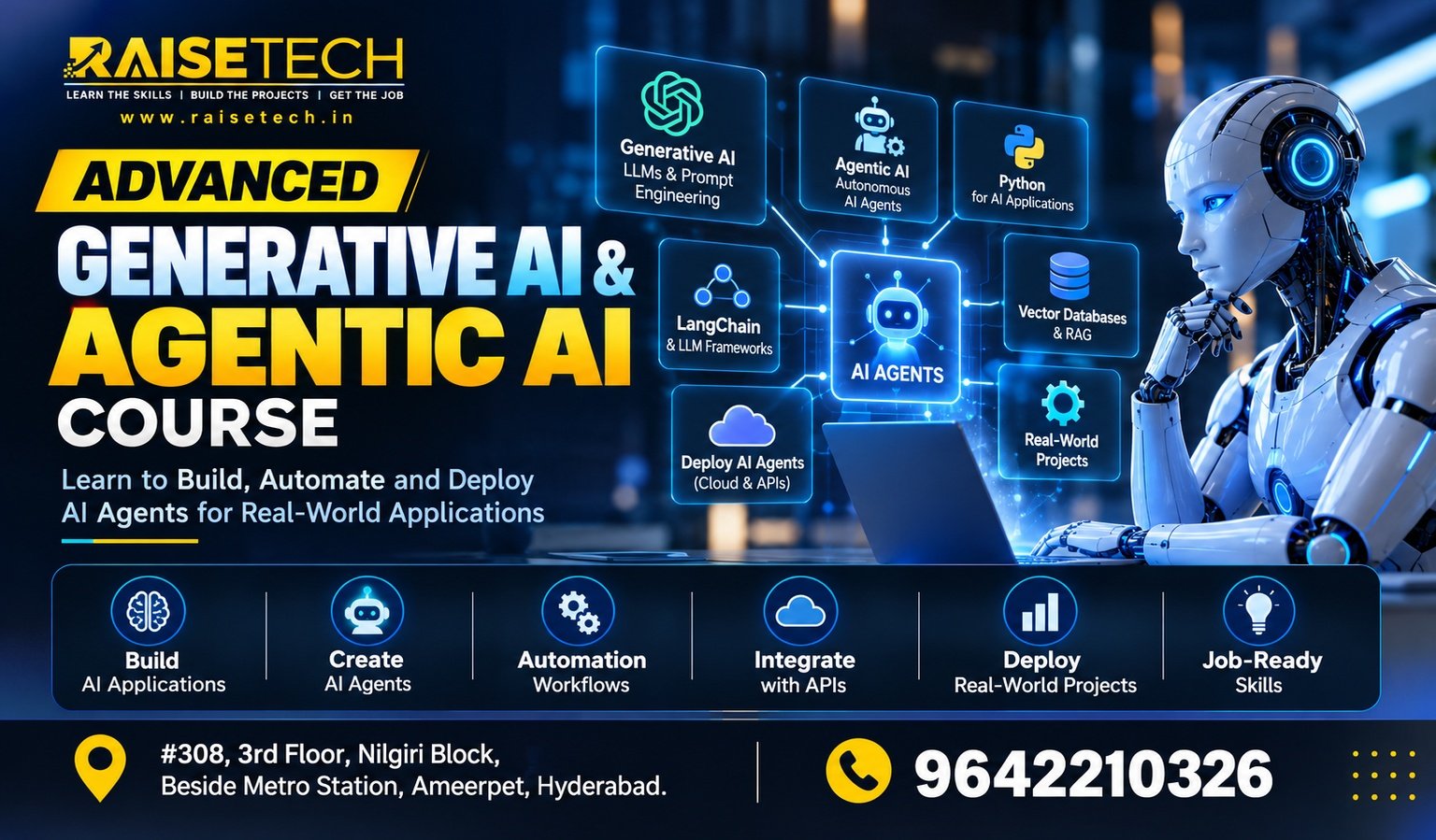
Generative AI can create text, code, summaries, and other content. Agentic AI goes a step further by helping systems plan tasks, use tools, and complete several steps to reach a goal. Together, these technologies are changing how developers build modern software.
At Raise Tech Institute, you can explore these technologies through a structured learning path. The course outline covers Large Language Models (LLMs), prompt engineering, document search, AI agents, and application development. In addition, you can learn how these tools work together to solve practical problems.
Whether you are a software developer, working professional, or learner with programming knowledge, this course can help you understand AI application development. Contact Raise Tech Institute in Ameerpet, Hyderabad, to confirm the latest syllabus, prerequisites, and batch details.
Learn about language models, transformers, embeddings, tokens, and prompts. These concepts form the basis of many modern AI applications.
Discover how document search, embeddings, and vector databases help AI applications find useful information. As a result, these systems can give answers based on relevant documents.
Explore AI agents that use tools, manage tasks, and follow multi-step workflows. You can also learn how these methods support business applications.
Learn Emerging Technologies
Building useful AI applications involves more than writing prompts. Developers also need to work with data, connect APIs, test results, and protect user information. Therefore, learning these skills can help you understand the full process of AI application development.
Learn how AI agents can use tools and follow set workflows. For example, they can help organise information or support repetitive business tasks.
Explore Retrieval-Augmented Generation (RAG). This method lets an AI application find useful details from documents and other approved data sources.
Learn the basics of AI assistants, chatbots, document question-answering tools, and workflow applications. You can then apply these ideas to project work.
Discover how AI applications connect with APIs, databases, and external services. These connections help applications perform useful tasks beyond text generation.
Understand why testing, retrieval quality, monitoring, and human review matter. These steps help teams find errors and improve AI application quality.
Build a foundation for further learning in Generative AI and AI application development. In addition, practical exercises can help you apply key concepts.
Your Learning Partner
Raise Tech Institute offers a learning path focused on AI concepts and application development. Contact our team in Ameerpet, Hyderabad, to learn about the current syllabus, faculty guidance, project work, and available batch schedules.
Start with Generative AI basics and progress to LLM applications, RAG systems, and AI agent workflows. This step-by-step approach helps you build your knowledge.
Explore how developers use AI to build chatbots, document assistants, and automated workflows. Practical examples can help you connect concepts with real tasks.
Study Python, APIs, LLM integrations, and AI frameworks. These skills are useful when building and connecting AI applications.
Use guided exercises to apply what you learn. For example, you can explore how an AI assistant handles user questions or retrieves information from documents.
Find out more about AI training at Raise Tech Institute in Ameerpet. Contact the team to confirm the classroom location, online options, and upcoming batches.
Ask about resume guidance, project presentation, interview preparation, and available career support. The team can explain which services are included with the course.
Course Syllabus
This curriculum outline introduces key topics used to build Generative AI applications and AI agents. You can explore the basics first, then move on to more advanced concepts. Please confirm the final syllabus, tools, and practical exercises with Raise Tech Institute before enrolment.
Practical Application Development
Projects help you put AI concepts into practice. The examples below show the types of applications you could explore during your learning journey. Please confirm which projects are included in the current course.
Explore a chat assistant that accepts questions and generates useful responses. You can also learn how an LLM API returns structured information.
Build or explore a system that searches documents for relevant information. It then uses that information to answer user questions.
Design a workflow that organises research tasks, processes information, and prepares summaries. Human review helps check the results.
Explore an agent that selects tools and follows a sequence of steps to complete a defined task. This can help you understand how agent workflows operate.
Learn how specialised agents can share tasks and coordinate their work. A defined workflow helps manage how each agent contributes.
Create a prototype that reviews approved business data and prepares summaries. A person should check the results before using them for decisions.
Eligibility
This course is designed for learners who want to build AI-powered applications. However, your suitability depends on your programming experience and knowledge of the required topics.
Explore LLM integrations, AI frameworks, retrieval systems, and intelligent workflows. These topics can help you add AI features to software applications.
Expand your technical knowledge into Generative AI, automation, and AI application development. You can then explore how these tools fit into your current role.
Build on your existing knowledge and explore language models, RAG systems, and agent-based applications. Basic programming skills will help you follow the practical work.
Learn how to connect language models with APIs, databases, and external tools. These skills can support the development of AI-powered applications.
Explore AI assistants, document search, knowledge retrieval, and workflow automation. For example, these tools can help users find information across approved data sources.
Develop AI project skills alongside your current technical experience. A portfolio of practical work can also help demonstrate what you have learned.
Technology Stack
AI application development combines programming, language models, data retrieval, APIs, and deployment tools. The technologies covered will depend on the final syllabus and the projects selected for your batch.
Instead of learning each tool in isolation, explore how the different parts work together. This approach can help you understand the structure of an AI application.
Your Learning Journey
A step-by-step learning path helps you understand the basics before moving on to more advanced applications. You can then use these skills in practical project work.
Learn about language models, tokens, embeddings, transformers, and prompts.
Explore document processing, search, vector retrieval, and answers based on relevant context.
Learn about planning, tool use, state management, and task-based workflows.
Apply your knowledge to AI assistants, document question-answering tools, and automation prototypes.
Explore evaluation, debugging, security, and deployment basics before releasing an application.
Explore Career Directions
Skills in LLM applications and AI workflows may support different technology career paths. However, your options will depend on your education, experience, project portfolio, and employer requirements.
Build applications that use language models, prompts, structured responses, and external services.
Develop software features that use AI models to support user needs and business workflows.
Work with model APIs, document retrieval, prompt design, and application integrations.
Build document search and question-answering systems that use relevant data and language models.
Explore workflows that connect AI tools, APIs, and multi-step task execution.
Help design and connect AI-powered tools based on technical needs and business goals.
Frequently Asked Questions
Find answers to common questions about the course, entry requirements, syllabus, projects, and training options at Raise Tech Institute.
This course explores how to build AI applications with language models, document retrieval, and AI agents. You can learn the main concepts and see how they fit into application development.
Raise Tech Institute serves learners looking for technology training in Ameerpet, Hyderabad. Contact the institute to confirm the current classroom address and available training formats.
Generative AI creates content such as text or code in response to a prompt. Agentic AI focuses on systems that can plan tasks, use tools, and follow steps towards a goal. Many agent systems use generative models as part of their design.
The proposed curriculum includes LLMs, transformers, prompt engineering, RAG, embeddings, vector databases, LangChain, AI agents, multi-agent systems, APIs, and deployment concepts. Contact the institute to confirm the final syllabus.
Python knowledge is recommended because many AI applications use code, APIs, and data handling. Ask the institute whether a foundation module or entry assessment is available.
The proposed curriculum covers RAG, including document processing, embeddings, vector search, and answers based on retrieved information. Confirm which tools and practical exercises are included in your batch.
The curriculum outline includes AI agent design, tool calling, task planning, workflow management, and multi-agent collaboration. Contact the institute for details about the practical sessions.
Possible project ideas include AI assistants, document question-answering tools, research workflows, and task automation agents. Ask Raise Tech Institute which projects are part of the current course.
Contact Raise Tech Institute to confirm current online options. You can also ask about batch timings, class format, practical sessions, and learning resources.
Ask about available career support, such as resume guidance, interview preparation, and job-related assistance. Confirm the services and terms before enrolment.
The duration depends on the syllabus, teaching schedule, and batch format. Contact the institute for the current timetable, course length, and upcoming start dates.
Contact Raise Tech Institute to discuss eligibility, syllabus, fees, batch schedules, and available learning formats. The team can explain the enrolment process and help you choose the next step.
Start Your AI Learning Journey
Looking for Advanced Generative & Agentic AI Training in Hyderabad? Contact Raise Tech Institute in Ameerpet to ask about the syllabus, entry requirements, available batches, fees, and practical learning options.
Learn how LLM-powered applications, RAG systems, AI agents, and automated workflows work. Then explore how these technologies can be used to build useful AI applications.
Raise Tech Institute | Ameerpet, Hyderabad