Best GCP Data Engineering Course in Hyderabad: Complete Guide to GCP Cloud Data Engineering
Cloud data engineering has become an important skill for modern technology teams. Companies use cloud platforms to collect, process, store, and analyze large amounts of data.
Google Cloud Platform (GCP) offers a strong set of tools for building modern data platforms. Therefore, learning GCP Data Engineering can help students and working professionals build practical cloud data skills.
If you are looking for the best GCP Data Engineering course in Hyderabad, you should look beyond basic cloud training. A good program should cover data engineering from start to finish.
This guide explains the key skills, tools, projects, and career areas you should look for in a GCP Data Engineering course.
What Is GCP Data Engineering?
GCP Data Engineering focuses on building data systems on Google Cloud. Data engineers create pipelines that move data from different sources into cloud platforms.
They also clean, transform, store, and monitor data. In addition, they make sure that data pipelines remain reliable and cost-effective.
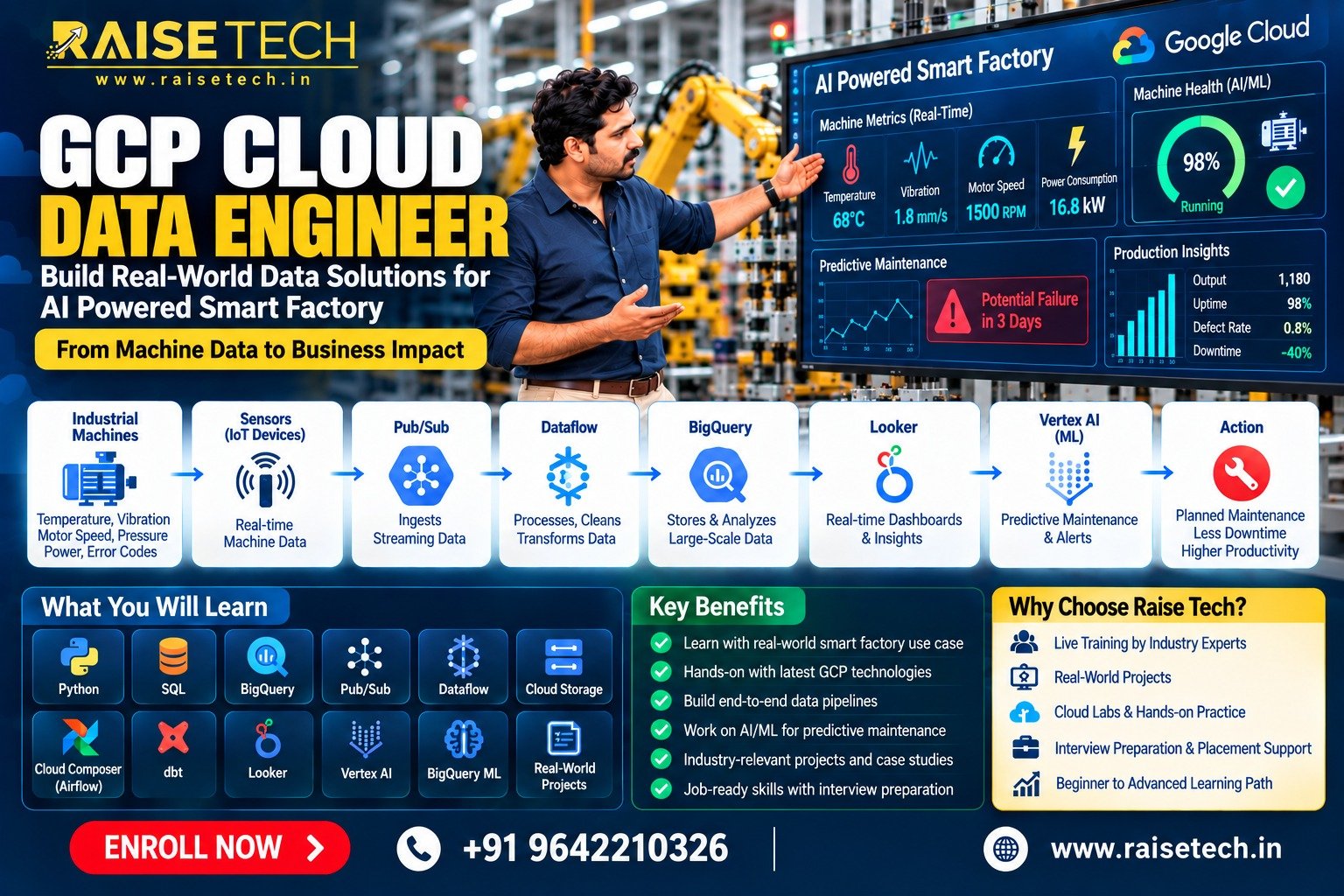
A typical GCP data engineering workflow can include:
- Collecting data from different sources
- Storing data in Cloud Storage
- Moving messages through Pub/Sub
- Processing data with Dataflow
- Processing large datasets with Dataproc
- Transforming data with SQL and PySpark
- Storing analytical data in BigQuery
- Scheduling workflows with Cloud Composer
- Managing infrastructure with Terraform
- Monitoring pipelines and data quality
As a result, GCP Data Engineering requires both cloud knowledge and strong programming skills.
Why Learn GCP Data Engineering?
Data continues to grow across almost every industry. Companies need engineers who can build systems that handle this data efficiently.
At the same time, cloud platforms have changed how companies build data systems. Teams can now scale infrastructure based on business needs.
GCP provides managed services that help engineers build these systems faster. Therefore, GCP skills can be useful for students, freshers, and experienced IT professionals.
Growing Demand for Cloud Data Skills
Modern companies use data for reporting, analytics, machine learning, and business decisions. Because of this, they need reliable data pipelines.
Data engineers help create and maintain these pipelines. They also work closely with data analysts, data scientists, cloud engineers, and software developers.
Strong Google Cloud Data Platform
Google Cloud provides several services for data engineering. BigQuery, Dataflow, Pub/Sub, Dataproc, Cloud Storage, and Cloud Composer are common examples.
Learning these services together gives you a better understanding of the complete data engineering lifecycle.
What Should the Best GCP Data Engineering Course in Hyderabad Cover?
A complete GCP Data Engineering course should not focus on only one or two cloud services.
Instead, it should teach the complete workflow. You should learn programming, data processing, cloud services, orchestration, infrastructure, monitoring, testing, and project development.
The following topics are important for a practical GCP Data Engineering program.
GCP Data Engineering Course Curriculum
1. SQL for Data Engineering
SQL is one of the most important skills for data engineers.
You should learn how to query, filter, join, group, and transform data. You should also understand subqueries, CTEs, window functions, and analytical queries.
These skills are especially useful when working with BigQuery.
2. Python for Data Engineering
Python is widely used in modern data engineering workflows.
A good course should cover Python fundamentals and practical data engineering concepts. You should learn functions, modules, file handling, error handling, APIs, and data processing.
Python also helps engineers automate repetitive tasks and build data pipeline components.
3. Google Cloud Fundamentals
Before building pipelines, you need to understand the Google Cloud environment.
This includes projects, regions, zones, IAM, service accounts, networking basics, storage, compute, and security concepts.
These fundamentals help you work with GCP services more effectively.
4. Google Cloud Storage
Cloud Storage provides scalable object storage on Google Cloud.
Data engineers can use it as a landing area for raw files and other data sources.
You should learn buckets, objects, storage classes, permissions, lifecycle rules, and data movement between services.
5. BigQuery
BigQuery is a major part of the Google Cloud data platform.
You should learn how to create datasets and tables, load data, write analytical queries, and optimize query performance.
The course should also cover partitioning, clustering, views, external tables, and cost optimization.
These skills help you build efficient analytical data solutions.
6. Pub/Sub
Pub/Sub supports event-driven and messaging-based architectures.
You should understand topics, subscriptions, publishers, subscribers, message delivery, and integration with data pipelines.
For example, Pub/Sub can receive streaming events before Dataflow processes them.
7. Dataflow and Apache Beam
Dataflow is a managed service for batch and streaming data processing.
Apache Beam provides the programming model used to build Dataflow pipelines.
You should learn pipeline concepts, transformations, windows, triggers, streaming data, batch processing, and pipeline optimization.
8. Dataproc and PySpark
Dataproc supports managed Spark and Hadoop workloads on Google Cloud.
PySpark is useful for processing large datasets with distributed computing.
A practical course should cover Spark DataFrames, transformations, actions, joins, aggregations, partitioning, and performance optimization.
9. Cloud Composer
Cloud Composer helps data teams manage and schedule workflows.
It uses Apache Airflow for workflow orchestration.
You should learn DAGs, operators, dependencies, scheduling, retries, monitoring, and pipeline automation.
10. Data Fusion
Cloud Data Fusion provides a visual environment for building data integration pipelines.
It can help teams connect different data sources and create data workflows with less custom code.
Understanding Data Fusion can add another useful skill to your GCP data engineering toolkit.
11. Terraform for Infrastructure
Modern data teams often use Infrastructure as Code.
Terraform helps engineers create and manage cloud resources through configuration files.
You should learn providers, resources, variables, modules, state management, and environment management.
This approach can make cloud infrastructure easier to manage and reproduce.
12. Git and CI/CD
Data engineers often work in team-based development environments.
Git helps teams manage source code and collaborate safely.
CI/CD helps automate testing and deployment.
Therefore, a practical GCP course should introduce Git workflows, branches, pull requests, automated testing, and deployment pipelines.
13. IAM and Security
Security is an important part of cloud data engineering.
You should understand IAM roles, permissions, service accounts, and access control.
You should also learn how to give users and applications only the permissions they need.
14. Monitoring and Troubleshooting
Data pipelines can fail for many reasons. A pipeline may have incorrect data, configuration problems, service errors, or performance issues.
Therefore, engineers need monitoring and troubleshooting skills.
A good program should cover logs, alerts, pipeline monitoring, error handling, retries, and debugging.
15. Data Quality and Testing
Reliable data is essential for analytics and business decisions.
Data engineers should check data accuracy, completeness, consistency, and freshness.
Testing should also cover pipeline logic, transformations, schema changes, and data validation.
16. Cost Optimization
Cloud resources have costs. Therefore, engineers should understand how their pipelines use cloud resources.
For example, BigQuery query optimization can help reduce unnecessary processing. Efficient storage and pipeline design can also reduce cloud spending.
A complete course should teach these practical cost optimization concepts.
Real-World GCP Data Engineering Projects
Projects help you understand how different GCP services work together.
A strong training program should include practical projects that follow real business scenarios.
Project 1: Batch Data Pipeline
Build a batch pipeline that collects files from Cloud Storage, processes the data, and loads the results into BigQuery.
This project can cover data ingestion, transformation, validation, and analytical storage.
Project 2: Real-Time Streaming Pipeline
Build a streaming pipeline using Pub/Sub and Dataflow.
The pipeline can process events in real time and store the results in BigQuery.
This project helps you understand streaming data and event-driven architecture.
Project 3: PySpark Data Processing
Use Dataproc and PySpark to process a large dataset.
You can apply transformations, joins, aggregations, and performance optimization techniques.
Project 4: Automated Data Workflow
Use Cloud Composer to schedule and manage a multi-step data pipeline.
The workflow can include data ingestion, transformation, validation, and BigQuery loading.
Project 5: Infrastructure and Deployment
Use Terraform to create GCP resources and Git-based workflows to manage code.
You can also add CI/CD to automate testing and deployment.
These projects help connect individual technologies into a complete engineering workflow.
GenAI in GCP Data Engineering
Generative AI is becoming part of modern software and data engineering workflows.
Data engineers can use AI tools to support coding, documentation, SQL development, debugging, testing, and data pipeline design.
However, engineers still need to understand the underlying systems.
Therefore, GenAI should support engineering skills rather than replace them.
A modern GCP Data Engineering course can introduce GenAI-assisted engineering as part of practical development.
Who Should Join a GCP Data Engineering Course?
GCP Data Engineering training can suit different types of learners.
- Freshers who want to start a career in data engineering
- Working professionals moving into cloud data roles
- Software developers who want to learn data engineering
- Data analysts who want to move into engineering roles
- Cloud professionals who want stronger data platform skills
- Professionals preparing for GCP Data Engineer interviews
You do not need to master every technology before starting. However, basic programming and database knowledge can make the learning process easier.
GCP Data Engineering Course in Hyderabad
Hyderabad has a large technology ecosystem with companies working across cloud computing, software development, analytics, and data platforms.
Ameerpet is also a popular training destination for students and working professionals.
When comparing GCP Data Engineering courses in Hyderabad, look at the curriculum, practical training, projects, instructor experience, interview preparation, and learning format.
Do not compare courses only by duration or price. Instead, check what you will actually learn and build during the program.
Online and Classroom GCP Data Engineering Training
Learning preferences can differ from person to person.
Some learners prefer classroom training because they can interact directly with trainers and other students.
Others prefer online training because it offers more flexibility.
Therefore, choose a learning format that matches your schedule and learning style.
A good training program should provide practical exercises in either format.
Career Opportunities After GCP Data Engineering Training
GCP Data Engineering skills can support several technology career paths.
Depending on your background and experience, you can explore roles such as:
- GCP Data Engineer
- Cloud Data Engineer
- Data Engineer
- Big Data Engineer
- Cloud Engineer
- ETL Developer
- Data Platform Engineer
- Analytics Engineer
Your career path will depend on your technical skills, experience, projects, and interview performance.
GCP Data Engineer Interview Preparation
Technical knowledge is only one part of interview preparation.
You should also practice explaining how you would design and troubleshoot data systems.
Important interview areas include:
- SQL queries
- Python programming
- BigQuery
- Dataflow
- Apache Beam
- Pub/Sub
- Dataproc
- PySpark
- Cloud Composer
- Terraform
- IAM
- Data pipeline design
- Data quality
- Cloud architecture
- Cost optimization
System design practice is also useful for experienced professionals.
How to Choose the Best GCP Data Engineering Course in Hyderabad
Before enrolling, compare the program against a clear checklist.
- Does the course cover SQL and Python?
- Does it cover BigQuery?
- Does it include Dataflow and Apache Beam?
- Does it cover Pub/Sub and streaming pipelines?
- Does it include Dataproc and PySpark?
- Does it teach Cloud Composer and workflow orchestration?
- Does it include Terraform?
- Does it cover Git and CI/CD?
- Does it teach IAM and cloud security?
- Does it include monitoring and troubleshooting?
- Does it cover data quality and testing?
- Does it include real-world projects?
- Does it include GenAI-assisted engineering?
- Does it provide interview and system-design preparation?
These questions can help you compare programs based on practical learning rather than marketing claims.
Why Practical Projects Matter in Data Engineering
Data engineering is a hands-on field.
Reading about BigQuery or Dataflow is useful. However, building a working pipeline gives you a deeper understanding.
Projects also help you learn how services connect with each other.
For example, a single project can combine Cloud Storage, Pub/Sub, Dataflow, BigQuery, Cloud Composer, Terraform, and monitoring.
This type of experience can also help you explain your technical work during interviews.
Skills You Can Build Through GCP Data Engineering Training
A complete program can help you build skills across several areas.
- SQL and analytical data processing
- Python programming
- PySpark and distributed processing
- Google Cloud services
- Batch and streaming pipelines
- BigQuery data warehousing
- Apache Beam and Dataflow
- Workflow orchestration
- Infrastructure as Code
- Git and CI/CD
- IAM and cloud security
- Monitoring and troubleshooting
- Data quality and testing
- Cloud architecture
- Cost optimization
- GenAI-assisted engineering
Frequently Asked Questions
What is GCP Data Engineering?
GCP Data Engineering involves building, managing, and optimizing data pipelines on Google Cloud. It includes data ingestion, processing, storage, transformation, orchestration, monitoring, and security.
Which GCP services should a data engineer learn?
Important services include BigQuery, Cloud Storage, Pub/Sub, Dataflow, Dataproc, Cloud Composer, and Data Fusion. You should also learn supporting technologies such as SQL, Python, PySpark, Apache Beam, Terraform, Git, and CI/CD.
Is GCP Data Engineering suitable for freshers?
Yes. Freshers can start learning GCP Data Engineering with basic programming and database knowledge. A structured course can help them build these skills step by step.
Can working professionals learn GCP Data Engineering?
Yes. Working professionals can learn GCP Data Engineering to build cloud skills or move toward data engineering roles. Online training can also provide flexibility for professionals with busy schedules.
Is Python required for GCP Data Engineering?
Python is an important skill for many data engineering workflows. It helps engineers automate tasks, build pipeline components, work with APIs, and process data.
Is SQL important for GCP Data Engineering?
Yes. SQL is essential for querying and transforming data. It is especially important when working with BigQuery and analytical data platforms.
What is the role of BigQuery in data engineering?
BigQuery is a cloud data warehouse used to store and analyze large datasets. Data engineers use it for analytical workloads, reporting, transformations, and data pipelines.
What is Dataflow used for?
Dataflow is used for batch and streaming data processing. It works with Apache Beam and can process data at scale.
What is PySpark used for?
PySpark allows engineers to process large datasets using Apache Spark. It is useful for distributed data processing and large-scale transformations.
Does a GCP Data Engineering course include projects?
A practical course should include projects that use real-world data engineering workflows. Projects can cover batch processing, streaming, PySpark, orchestration, infrastructure, and deployment.
Does GCP Data Engineering include GenAI?
Modern data engineering workflows can use GenAI for coding, SQL development, documentation, testing, debugging, and other engineering tasks. A modern course can introduce these use cases as part of practical training.
Start Your GCP Cloud Data Engineering Journey
If you are researching the best GCP Data Engineering course in Hyderabad, review the curriculum carefully. Compare the practical components. Also, check whether the program covers the full engineering lifecycle rather than only introductory cloud services.
Raise Tech provides a structured GCP Data Engineer program covering SQL and Python foundations, BigQuery, PySpark, Dataflow, Composer, Terraform, architecture, real-world projects, GenAI, and interview and system-design preparation.
The program is designed for learners who want practical cloud data engineering skills through structured training and project-based learning.
Ready to learn more? Visit Contact Us to discuss the course and available training options.
Join GCP Data Engineering Training at Raise Tech
Build practical skills in Google Cloud data engineering with SQL, Python, BigQuery, Dataflow, Dataproc, PySpark, Cloud Composer, Terraform, projects, and GenAI-assisted engineering.
Take the next step toward building your cloud data engineering career.
Raise Tech
Website: www.raisetech.in
Phone: 9642210326