GCP Cloud Data Engineer Training in Ameerpet, Hyderabad: How AI-Powered Smart Factories Use Real-Time Data
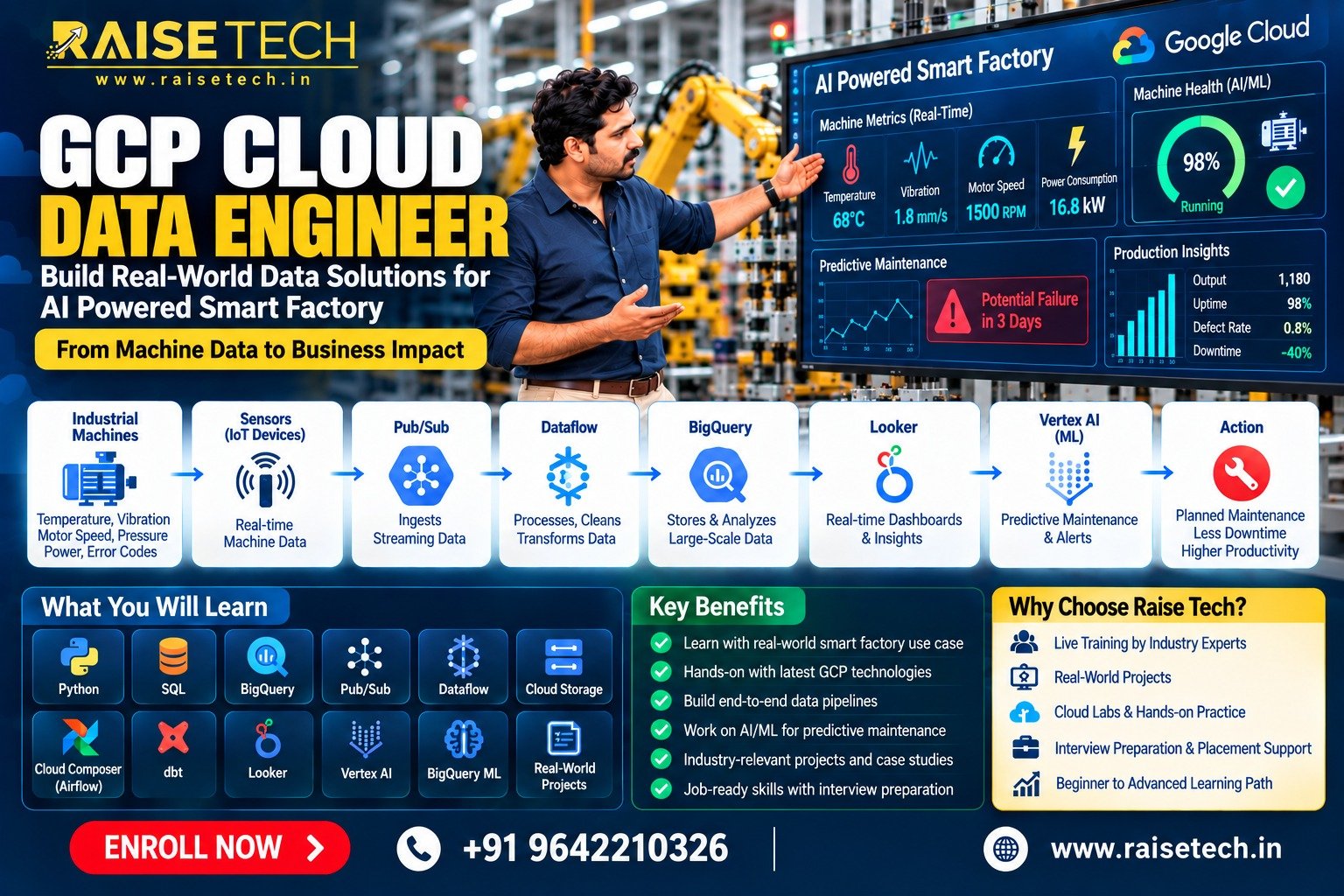
A practical example is an AI-powered smart factory where industrial machines continuously send sensor data to a Google Cloud data platform.
A typical architecture can look like this:
Machine Sensors → Pub/Sub → Dataflow → BigQuery → Looker → ML / Alerts → Maintenance Action
Google Cloud describes Pub/Sub as an asynchronous messaging service that can ingest and distribute streaming events. Dataflow supports both batch and streaming data processing, while BigQuery is designed for large-scale analytics. Looker can then be used to explore and visualize data through dashboards.
This example helps explain why GCP Cloud Data Engineering is much more than simply learning individual cloud services.
What Is GCP Cloud Data Engineering?
GCP Cloud Data Engineering focuses on building systems that collect, process, store, transform and analyze data on Google Cloud.
A Cloud Data Engineer works with technologies such as:
- Python
- SQL
- BigQuery
- Pub/Sub
- Dataflow
- Apache Beam
- Cloud Storage
- Cloud Composer
- Airflow
- dbt
- Looker
- Vertex AI
- BigQuery ML
- Git
- Terraform
The current GCP Data Engineering program at Raise Tech covers Python, advanced SQL, BigQuery, Dataflow, Pub/Sub, Apache Beam, Cloud Storage, Cloud Composer, Airflow, dbt, BigQuery ML and Vertex AI.
The important point is that these technologies are connected.
A professional data pipeline could follow this pattern:
The smart factory provides a very clear example.
AI-Powered Smart Factory: A Real-World GCP Data Engineering Example
Imagine a large manufacturing facility with hundreds of industrial machines.
Every machine has sensors.
These sensors continuously generate information such as:
- Temperature
- Vibration
- Motor speed
- Pressure
- Power consumption
- Operating hours
- Error codes
For example, consider one industrial motor.
| Metric | Initial Reading | Later Reading |
|---|---|---|
| Temperature | 68°C | 78°C |
| Vibration | 1.8 mm/s | 4.7 mm/s |
| Motor Speed | 1500 RPM | 1390 RPM |
| Power Consumption | 16.8 kW | 21.2 kW |
Individually, these numbers may not immediately explain the problem.
But when thousands of sensor readings are collected over time, a data engineering platform can help the organization analyze the pattern.
This is where the GCP pipeline becomes useful.
Step 1: Machines Generate Sensor Data
The first stage is the physical machine.
Sensors continuously measure machine conditions.
For example:
Suppose a motor starts vibrating more than usual.
Instead of waiting until the motor completely fails, the organization can capture that changing signal as data.
The objective is not simply to collect numbers.
The objective is to make those numbers available for analysis.
Step 2: Pub/Sub Receives Real-Time Data
The next stage is Google Cloud Pub/Sub.
Pub/Sub is designed for asynchronous messaging and streaming data integration. Google Cloud documentation describes it as a service that decouples systems producing messages from systems processing them.
In our smart factory example:
Every sensor event can become a message.
For example:
- Machine ID: M-103
- Temperature: 78°C
- Vibration: 4.7 mm/s
- Motor Speed: 1390 RPM
- Power: 21.2 kW
- Timestamp: 10:42:18
Pub/Sub receives and distributes these events so downstream systems can process them.
This is one reason streaming data engineering is important in modern industrial environments.
Step 3: Dataflow Processes the Streaming Data
Raw sensor data is not automatically ready for analysis.
It may contain:
- Missing values
- Invalid readings
- Incorrect formats
- Duplicate events
- Inconsistent timestamps
- Unexpected sensor values
This is where Dataflow can become part of the pipeline.
Google Cloud describes Dataflow as a service for unified batch and stream processing. It can read data from sources, transform it and write it to destinations. Google also lists sensor-data processing and real-time ML analysis among Dataflow use cases.
The factory pipeline becomes:
Dataflow can perform transformations such as:
For example, it could identify that a temperature reading is invalid, standardize timestamps and prepare the event for storage and analysis.
Dataflow supports Apache Beam as its programming model for batch and streaming pipelines.
Step 4: BigQuery Stores and Analyzes Machine Data
Once the streaming data has been processed, it can be made available in BigQuery.
The architecture now becomes:
Machine → Pub/Sub → Dataflow → BigQuery
BigQuery is Google’s fully managed analytics data warehouse and is designed to analyze large datasets using GoogleSQL and other supported workflows.
This is where historical and current machine data can become valuable.
Imagine that the factory has collected six months of data.
The team could investigate questions such as:
- Which machines show increasing vibration?
- Which machines consume more power?
- Does temperature increase before failures?
- Which motors frequently slow down?
- Which machines require maintenance more often?
- Are certain operating conditions associated with abnormal behavior?
Instead of looking at one sensor reading, engineers can analyze patterns across large datasets.
Step 5: Looker Turns Data Into Machine Insights
Raw tables are useful for engineers, but operations teams often need a visual view.
This is where Looker can be used.
The pipeline becomes:
Looker provides tools for querying, visualizing and organizing data through dashboards.
Imagine a factory dashboard showing:
| Machine | Temperature | Vibration | Motor Speed | Status |
|---|---|---|---|---|
| Machine A | 65°C | 1.5 mm/s | 1500 RPM | Normal |
| Machine B | 71°C | 3.1 mm/s | 1460 RPM | Warning |
| Machine C | 78°C | 4.7 mm/s | 1390 RPM | Abnormal |
Now the operations team can quickly see which machines require attention.
The dashboard transforms complex machine data into information that people can act on.
Step 6: Machine Learning Helps With Predictive Maintenance
This is where the AI component becomes interesting.
Suppose historical data shows that a combination of:
- Increasing vibration
- Rising temperature
- Decreasing motor speed
- Increasing power consumption
often appears before a machine requires maintenance.
A machine-learning system can use historical data to help identify similar patterns in new data.
The conceptual flow becomes:
For example:
Machine C
Vibration: Increasing
Temperature: Increasing
Motor Speed: Decreasing
Power Consumption: Increasing
The system can generate an alert for further investigation.
The maintenance team can then inspect the machine and decide whether maintenance should be scheduled.
This is an important distinction.
The data platform does not magically “repair” the machine.
Instead, it helps convert machine signals into timely information that can support maintenance decisions.
How Predictive Maintenance Can Reduce Unexpected Downtime
Consider the traditional approach.
This can create unexpected downtime.
A predictive-maintenance workflow aims to identify warning signals earlier:
The organization can then investigate the machine before an unexpected breakdown occurs.
The potential business impact includes:
- Better visibility into machine health
- Earlier identification of unusual patterns
- More planned maintenance
- Reduced unexpected downtime
- Better maintenance planning
- Improved operational decision-making
The exact business benefit depends on the factory, equipment, data quality and maintenance process.
The Complete GCP Smart Factory Architecture
The entire project can be understood through one simple architecture:
INDUSTRIAL MACHINE
↓
SENSORS
↓
TEMPERATURE / VIBRATION / SPEED / PRESSURE / POWER
↓
PUB/SUB
↓
DATAFLOW
↓
BIGQUERY
↓
LOOKER
↓
MACHINE LEARNING
↓
EARLY WARNING
↓
PLANNED MAINTENANCE
↓
BETTER MACHINE RELIABILITY
This is the type of end-to-end thinking a learner should develop when studying cloud data engineering.
What Does a GCP Cloud Data Engineer Actually Learn?
Learning GCP Data Engineering is not only about memorizing Google Cloud services.
A structured learning path should connect programming, databases, cloud services, and data pipelines.
1. Python
Python is useful for writing data-processing logic, automation, and pipeline-related applications.
2. Advanced SQL
SQL is essential for querying, transforming, and analyzing structured data.
3. BigQuery
Learners need to understand:
- Tables
- Queries
- Data modeling
- Partitioning
- Clustering
- Performance
- Cost considerations
4. Pub/Sub
Learners understand how event-driven and streaming data can enter a cloud architecture.
5. Dataflow and Apache Beam
These technologies help learners understand batch and streaming data processing.
6. Cloud Storage
Cloud Storage can be used as part of cloud data architectures for storing files and data.
7. Cloud Composer and Airflow
Orchestration becomes important when multiple data-processing tasks need to run in a defined sequence.
8. dbt
Modern data teams may use dbt for transformation workflows, particularly around analytics platforms.
9. Looker
Visualization helps convert processed data into dashboards and business insights.
10. BigQuery ML and Vertex AI
The current Raise Tech GCP program also introduces AI-oriented capabilities, including BigQuery ML and Vertex AI.
Why Real-World Projects Matter
A learner can memorize what Pub/Sub, Dataflow, and BigQuery are.
But that is different from understanding how they work together.
A project provides the connection.
Example: Predictive Maintenance in Manufacturing
Problem: Industrial machines experience unexpected failures.
Data: Machine sensor readings.
Ingestion: Pub/Sub.
Processing: Dataflow.
Storage and analytics: BigQuery.
Visualization: Looker.
AI: Machine-learning analysis.
Business action: Planned maintenance.
This gives learners a complete story from raw data to business action.
Raise Tech’s current GCP Data Engineering program includes a real-time streaming project using Pub/Sub and Dataflow with BigQuery, along with an end-to-end ELT project, an orchestrated data platform, and an AI analytics layer.
Who Can Learn GCP Cloud Data Engineering?
GCP Cloud Data Engineering can be considered by people interested in:
- Cloud computing
- Data engineering
- Big data
- SQL
- Python
- Analytics
- AI and machine learning
- Real-time data pipelines
The current Raise Tech GCP program states that it starts with GCP fundamentals and is designed from beginner level toward job-ready skills.
However, completing a course alone does not guarantee a particular job. Practical skills, projects, problem-solving ability, communication, and interview performance also matter.
GCP Cloud Data Engineer Career Path
A possible learning progression is:
- Python
- Advanced SQL
- Data Modeling
- BigQuery
- Pub/Sub
- Dataflow + Apache Beam
- Cloud Composer + Airflow
- dbt
- Looker
- BigQuery ML + Vertex AI
- Real-World Projects
This progression helps learners move from fundamentals to complete cloud data platforms.
Raise Tech currently lists potential target roles including Data Engineer, Analytics Engineer, Cloud Data Engineer, and BI Engineer.
Why GCP Data Engineering Is Important for AI
AI systems depend heavily on data.
A machine-learning model is only one component of a larger system.
Before AI can provide useful results, organizations often need to:
- Collect data
- Ingest data
- Clean data
- Transform data
- Store data
- Analyze data
- Build features
- Run models
- Monitor results
- Take action
That is why data engineering and AI increasingly work together.
GCP Data Engineering in a Smart Factory
Sensors create data.
Data engineering moves and prepares the data.
BigQuery analyzes the data.
AI identifies useful patterns.
Dashboards communicate the insight.
Operations teams take action.
This is the bigger picture of modern cloud data engineering.
Why Choose a GCP Cloud Data Engineer Course?
When evaluating a GCP Data Engineer course, look beyond the technology names.
A good learning program should provide opportunities to practice:
- Python
- SQL
- Cloud fundamentals
- Data modeling
- Streaming pipelines
- Batch processing
- BigQuery
- Dataflow
- Pub/Sub
- Workflow orchestration
- Data visualization
- AI integration
- Real-world projects
The current Raise Tech GCP Data Engineering program includes live cohort learning, cloud labs, production-oriented pipelines, and projects covering real-time streaming, orchestration, and AI analytics.
You can explore the current curriculum here:
GCP Data Engineering with AI course at Raise Tech
GCP Cloud Data Engineer Course in Hyderabad
For learners looking for GCP Data Engineering training in Hyderabad, Raise Tech currently offers its GCP Data Engineering with AI program from Ameerpet, Hyderabad.
The current program lists:
- 6-month duration
- Live cohort + cloud labs
- Beginner-to-job-ready progression
- Python
- Advanced SQL
- BigQuery
- Dataflow
- Pub/Sub
- Apache Beam
- Cloud Composer
- Airflow
- dbt
- Looker Studio
- Vertex AI
- BigQuery ML
- Real-world projects
- Interview preparation and referrals
You can also explore Raise Tech’s broader technology programs and AI-focused learning approach on the main website.
Explore Raise Tech’s AI-powered technology courses
Frequently Asked Questions
What is GCP Cloud Data Engineering?
GCP Cloud Data Engineering involves building systems on Google Cloud to collect, process, store, transform, and analyze data.
Is GCP Data Engineering difficult for beginners?
It can be challenging because it combines programming, SQL, cloud services, and data concepts. A structured learning path can make the progression easier.
What is Pub/Sub used for?
Pub/Sub is a Google Cloud messaging service used to receive and distribute events and streaming data between systems.
What is Dataflow used for?
Dataflow is used for batch and streaming data processing. It can transform data between sources and destinations and is commonly used for streaming pipelines.
Why is BigQuery important?
BigQuery provides a managed analytics data warehouse for analyzing large datasets using GoogleSQL and related capabilities.
What is predictive maintenance?
Predictive maintenance uses equipment data and analytical or machine-learning techniques to identify patterns that may indicate a potential maintenance need.
Can GCP Data Engineering be used in manufacturing?
Yes. Sensor data from industrial equipment can be ingested, processed, stored, and analyzed through cloud data pipelines. Google Cloud specifically documents streaming and sensor-data processing use cases for Dataflow.
What roles can a GCP Data Engineering learner target?
Depending on skills and experience, possible roles include Data Engineer, Cloud Data Engineer, Analytics Engineer, and BI Engineer.
Final Takeaway
The future of manufacturing is not only about machines.
It is also about the data generated by those machines.
An AI-powered smart factory demonstrates this clearly.
A machine generates sensor data.
Pub/Sub receives events.
Dataflow processes the streaming data.
BigQuery stores and analyzes it.
Looker turns the data into dashboards.
Machine learning can help identify unusual patterns.
The maintenance team receives an early signal and can investigate the equipment before an unexpected failure.
The Complete Data Engineering Journey
That is why learning GCP Cloud Data Engineering through real-world projects can be more meaningful than learning cloud services individually.
If you want to understand how these technologies work together, explore the current GCP Data Engineering with AI curriculum at Raise Tech.