Data Science End-to-End Project: AI-Powered Healthcare Intelligence Platform
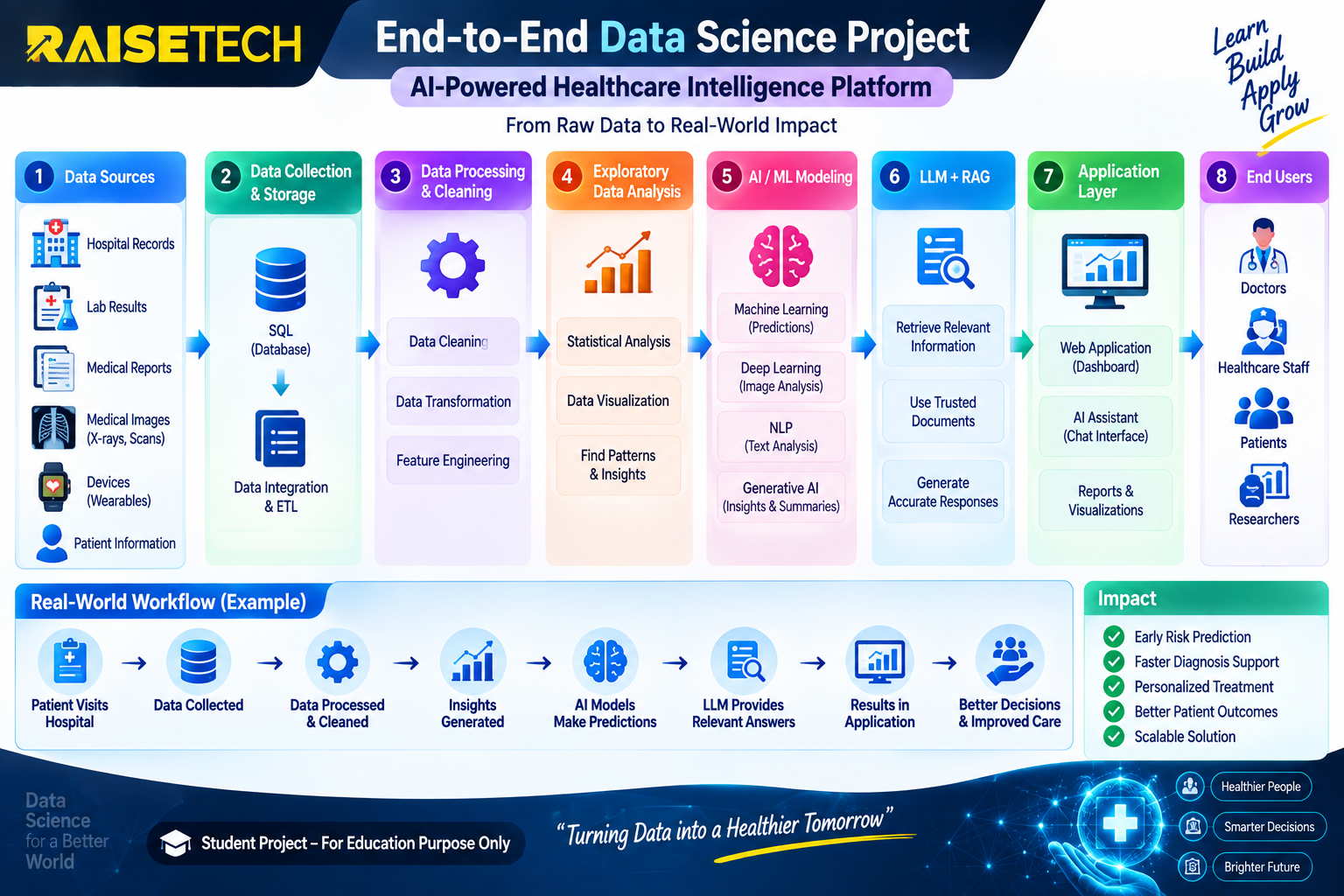
A practical project guide from raw data to an AI-powered application.
Project Objective
Learn how Python, SQL, Statistics, Machine Learning, Deep Learning, NLP, Computer Vision, LLMs, RAG and Generative AI work together in a practical Data Science End-to-End Project.
This approach helps learners understand the complete journey from raw data to an AI-powered application.
Project Overview
This project explains how a complete Data Science project works from start to finish. Instead of studying each technology separately, students can see how different tools connect inside one project.
In this example, we build an AI-Powered Healthcare Intelligence Platform. The platform brings together structured patient information, laboratory data, documents, images and historical records.
Then, it processes this information and presents useful analytical results through an application.
The project focuses on learning and practical training. It does not replace doctors or make autonomous medical decisions.
The Problem We Are Solving
Healthcare organizations often manage information across databases, laboratory systems, documents, images and previous visit records. As a result, users may spend significant time searching for the right information.
This project aims to bring relevant information into one intelligent workflow. Therefore, an authorized user can access data, analyze patterns and review AI-assisted results from one application.
For example, a patient visit may include symptoms and laboratory results. Previous visits may also contain older records.
A medical report may exist as text, while an X-ray may exist as an image. The platform processes these different data types and connects the results.
End-to-End Data Science Project Flow
First, the project collects data from the required sources. Next, SQL and Python prepare the data. Then, Statistics and EDA help the team understand patterns.
After that, Machine Learning and Deep Learning models handle specific analytical tasks. Finally, NLP, Computer Vision, LLMs and RAG connect the results to an AI-powered application.
Complete Project Workflow
| Step | Stage | Purpose |
|---|---|---|
| 1 | Data Sources | Collect patient records, laboratory results, reports, images and historical data |
| 2 | SQL & Data Collection | Retrieve and combine structured records |
| 3 | Python Processing | Clean, transform and prepare data |
| 4 | Statistics & EDA | Understand distributions, relationships and patterns |
| 5 | Machine Learning | Build prediction or classification models |
| 6 | Deep Learning | Learn complex patterns from suitable data |
| 7 | NLP | Extract useful information from text |
| 8 | Computer Vision | Process and analyze suitable images |
| 9 | LLM + RAG | Retrieve approved information and generate context-based responses |
| 10 | Application | Present results through a dashboard or web interface |
| 11 | Deployment | Deploy, monitor and improve the solution |
Understanding Each Stage With an Example
Data Collection
First, the project identifies the information it needs. This may include patient profiles, symptoms, laboratory values, previous visits, reports and images.
Project Example: The system uses a Patient ID to connect current visit information with previous records.
SQL and Database
Next, the team stores structured information in relational database tables. SQL helps retrieve, filter and join the required records.
Project Example: An SQL query can combine patient details, laboratory results and visit history using a common Patient ID.
Python Data Processing
After collecting the data, Python helps the team inspect missing values, remove duplicates, standardize formats and transform fields.
Next, the team prepares the dataset for analysis and model development.
Project Example: Python can convert laboratory values from different formats into one consistent format.
Learn more about practical Python development through Python Full Stack Training in Hyderabad.
Statistics and Exploratory Data Analysis
Once the data is ready, Statistics and Exploratory Data Analysis (EDA) help the team understand the dataset before model development.
Project Example: The team studies distributions, correlations and unusual values. This process can reveal useful patterns and data-quality problems.
Machine Learning
Next, the team uses prepared data to train a Machine Learning model for a defined prediction or classification task.
The team then evaluates the model with suitable metrics. The evaluation helps determine whether the model performs appropriately for the defined task.
Project Example: A model can estimate a risk category from historical information. However, the result serves as analytical support and not as a medical diagnosis.
Deep Learning
Deep Learning can handle complex patterns in suitable data such as images, text and high-dimensional features. Therefore, it can extend the project beyond traditional Machine Learning.
Project Example: A trained image model can analyze an X-ray dataset and produce an output for professional review.
Natural Language Processing
Natural Language Processing (NLP) helps the system understand and process unstructured text. It can extract useful information and prepare that information for search or analysis.
Project Example: The NLP pipeline can identify relevant conditions, dates, measurements and other entities from a report.
Computer Vision
Computer Vision handles image data. First, the system prepares the image. Next, the model processes it. Finally, the application presents the model output for review.
Project Example: The system can standardize a medical image and send it to a trained Computer Vision model.
LLM and Generative AI
Large Language Models (LLMs) add a natural-language layer to the application. They can summarize approved information and help users interact with data using natural language.
Project Example: An authorized user can ask the application for a concise summary of relevant records.
Retrieval-Augmented Generation
Retrieval-Augmented Generation (RAG) adds a retrieval step before the LLM generates an answer.
First, the system searches an approved knowledge base. Next, it sends relevant information to the LLM. The LLM then generates a response using that context.
Project Example: An organization can use RAG to answer questions about its approved guidelines and internal documents.
Application Layer
After the AI and analytics components are ready, the application connects them into one usable interface.
The application can connect the backend, database, analytics models and AI services.
Project Example: A dashboard can display patient information, trends, model outputs, document summaries and an AI search area.
Deployment and Monitoring
Finally, the team deploys the application and monitors its performance.
The team can track data quality, model behavior, application performance and user feedback. Over time, real-world data may change.
Therefore, the team may need to review model performance and retrain models when required.
Project Example: A major change in incoming data can trigger a model-performance review.
How the Technologies Connect
Core Architecture
User → Application → Backend → Database / Data Sources → Python Processing → ML / DL / NLP / Computer Vision → LLM + RAG → Results → Application → User
The key learning point is how these technologies connect. SQL supplies structured information. Then, Python prepares the data.
Statistics helps explain patterns. Machine Learning and Deep Learning create analytical models. At the same time, NLP and Computer Vision handle text and images.
Finally, LLM and RAG add a natural-language intelligence layer. The application brings these results together and presents them to the user.
In this way, students can understand how individual technologies contribute to one complete Data Science solution.
Example User Journey
The following example shows how an authorized user can interact with the complete platform.
- First, an authorized user opens the application and searches for a patient record.
- Next, the application retrieves relevant records from the database.
- Then, the system combines new laboratory information with historical information.
- After that, the analytics layer calculates trends and model outputs.
- Next, the NLP component processes relevant reports and extracts useful information.
- At the same time, the Computer Vision component processes available images.
- For a knowledge-based question, the RAG system retrieves relevant approved information.
- Then, the LLM generates a readable response using the retrieved context.
- Finally, the application presents the results in a structured dashboard.
How a Student Should Analyze This Project
A student should study the project by asking questions at every stage.
- What problem does the project solve?
- What data does the project need?
- Where does the data come from?
- How should the team clean the data?
- What patterns should the team find?
- Which model should the team use?
- How will the team evaluate the model?
- How will the result reach the user?
This approach helps students understand the reason behind each technology. Instead of memorizing tools, they learn how to choose and connect technologies based on a real project requirement.
Project Decision Framework
| Question | Project Decision | Learning |
|---|---|---|
| What is the problem? | Create an intelligent healthcare information platform | How projects start with a real problem |
| What data is available? | Structured data, text and images | How data type affects the solution |
| How is data prepared? | SQL + Python | Data processing fundamentals |
| How are patterns understood? | Statistics + EDA | Analytical thinking |
| How are predictions made? | Machine Learning + Deep Learning | Model development and evaluation |
| How is text handled? | NLP | Unstructured data processing |
| How are images handled? | Computer Vision | Image intelligence |
| How does AI answer questions? | LLM + RAG | Generative AI architecture |
| How does the user access it? | Application / Dashboard | Turning models into useful applications |
| How does the system improve? | Monitoring + Feedback + Retraining | Real-world Machine Learning lifecycle |
From Project to Real-World Product
A Machine Learning model alone does not make a complete product. A real solution also needs an application, secure data access, monitoring, validation and suitable domain expertise.
In addition, organizations must consider applicable privacy, security and regulatory requirements. Depending on the business need, teams can develop this type of platform as an enterprise analytics solution, subscription software or customized organizational application.
The business value comes from solving practical problems. For example, the platform can reduce the effort needed to find information, improve data visibility, support analysis and make approved knowledge easier to access.
Final End-to-End View
A complete Data Science project follows a connected path from raw data to a deployed application. Each stage adds value and prepares information for the next stage.
RAW DATA
↓
SQL + DATA COLLECTION
↓
PYTHON + DATA PREPARATION
↓
STATISTICS + EDA
↓
MACHINE LEARNING
↓
DEEP LEARNING
↓
NLP + COMPUTER VISION
↓
LLM + RAG
↓
GENERATIVE AI APPLICATION
↓
DASHBOARD / USER APPLICATION
↓
DEPLOYMENT
↓
MONITOR → IMPROVE → RETRAIN
Final Takeaway
A strong Data Science professional does more than learn individual tools. They understand how data moves through a complete system.
They also understand why each technology is used, how models support the application and how the system can improve after deployment.
Therefore, an end-to-end project gives students a practical way to connect their knowledge of Python, SQL, Statistics, Machine Learning, Deep Learning, NLP, Computer Vision, LLMs, RAG and Generative AI.
Suggested Student Deliverables
Students can demonstrate their understanding of the complete Data Science End-to-End Project by preparing the following deliverables:
- Problem statement and project objective
- Data-source description and data dictionary
- SQL database design and sample queries
- Python data-cleaning and preprocessing notebook
- Exploratory Data Analysis and visualizations
- Machine Learning model and evaluation report
- Deep Learning / Computer Vision prototype where applicable
- NLP processing pipeline
- LLM + RAG prototype
- Application dashboard or web interface
- Deployment architecture
- Final project report and presentation
Why End-to-End Projects Matter in Data Science
Learning individual Data Science technologies gives students technical knowledge. However, an end-to-end project shows how professionals connect those technologies to solve a practical problem.
Students can therefore move from isolated exercises to a complete workflow that includes data preparation, analytics, machine learning, AI integration and application development.
This project-based approach can also help learners explain their work more clearly during technical discussions and project presentations.
Data Science End-to-End Project at Raise Tech
At Raise Tech, practical project exposure helps learners connect classroom concepts with real-world development workflows.
A Data Science End-to-End Project can bring together Python, SQL, Statistics, Machine Learning, Deep Learning, NLP, Computer Vision, LLMs, RAG and Generative AI in one structured learning experience.
Instead of learning every technology in isolation, learners can understand how each component contributes to the complete solution.
Build Your Data Science Skills With Practical Projects
Explore Data Science training and project-based learning with Raise Tech in Ameerpet, Hyderabad.
Conclusion
This Data Science End-to-End Project shows how multiple technologies can work together to build an AI-powered application.
Instead of learning Python, SQL, Machine Learning, Deep Learning, NLP, Computer Vision, LLMs and RAG as separate technologies, students can understand how each component contributes to one complete workflow.
As a result, the project provides a practical foundation for modern Data Science, Artificial Intelligence and Generative AI applications in a healthcare-oriented environment.
For students looking to build practical Data Science skills, projects like this also provide a useful way to understand how classroom concepts connect with real-world applications.